Get phone and SMS alerts fromNVADR (RedHunt Labs)
NVADR by RedHunt Labs continuously maps your external attack surface and flags exposed assets, leaked secrets, and new vulnerabilities. NVADR has no outbound webhook, so a small forwarder polls its Issue Tracker API and posts each new or changed issue to Spike, which opens an incident and pages the on-call engineer by phone, SMS, Slack, or email until someone acknowledges it.
Set up with AI
I use NVADR (RedHunt Labs) for monitoring and Spike for on-call and incident management. Walk me through connecting them: create a NVADR (RedHunt Labs) integration in Spike, copy its webhook URL, and add that webhook to NVADR (RedHunt Labs) alert settings. Then help me send a test alert to confirm incidents show up in Spike.
What is NVADR (RedHunt Labs)?
NVADR is RedHunt Labs’ attack surface management platform. It discovers the internet-facing assets your organisation owns and keeps watching them for new exposures, misconfigurations, leaked credentials, and vulnerabilities, tracking each one as an issue.
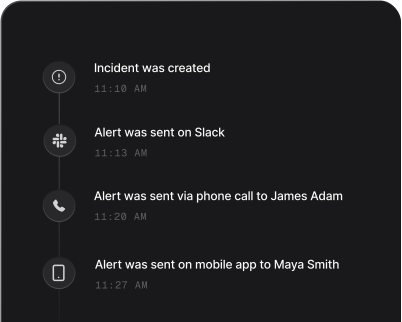
Findings like these are time-sensitive, yet a dashboard entry is easy to miss. NVADR can notify Slack, email, Jira, PagerDuty, and Datadog, but it does not offer a documented webhook. With a forwarder in between, each new or changed NVADR issue reaches Spike as an incident that calls and texts the engineer on rotation, escalates to the next tier when nobody acknowledges it, and groups repeat updates into a single thread rather than a pile of pages. When the forwarder sends an issue as CLOSED or WON’T FIX, the incident closes itself.
How to set up NVADR (RedHunt Labs) alerts
Every Spike integration is a unique webhook URL. Paste it into NVADR (RedHunt Labs) and alerts start flowing — no agents, no code.
Step 1: Create an NVADR integration in Spike
In your Spike dashboard, open Integrations and choose NVADR (RedHunt Labs). Spike generates a unique webhook URL for this integration — copy it.
Step 2: Create an NVADR API key and run the forwarder
In NVADR, create an API key. Then run a forwarder, such as a scheduled script, that uses the key to poll the NVADR Issue Tracker API and POSTs each new or changed issue to the Spike webhook URL. When an issue is marked CLOSED or WON'T FIX, the forwarder sends that status so Spike can resolve the incident.
Step 3: Send a test payload
POST a sample issue body to the Spike webhook URL, or run the forwarder once against your account. It opens an incident in Spike and pages whoever is on call, following your escalation policy.
That's it — NVADR (RedHunt Labs) alerts now page whoever is on call.