Get phone and SMS alerts fromPapertrail
Papertrail tails your logs in real time and keeps watch on the searches you save. When one of those searches finds new matching lines, Spike turns the alert into an incident — paging the on-call engineer by phone, SMS, Slack, and email, and escalating until someone picks it up.
Set up with AI
I use Papertrail for monitoring and Spike for on-call and incident management. Walk me through connecting them: create a Papertrail integration in Spike, copy its webhook URL, and add that webhook to Papertrail alert settings. Then help me send a test alert to confirm incidents show up in Spike.
What is Papertrail?
Papertrail is SolarWinds’ hosted log management service: it collects syslog, application logs, and container output from every machine you run, streams them into a live tail you can watch in the browser, and lets you search across the lot in seconds. Searches you run often can be saved, and a saved search can raise an alert whenever new lines match it — an exception signature, a failed deploy, an authentication error, a queue worker that has started logging retries.
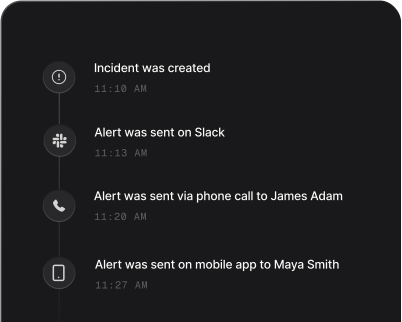
On its own, a Papertrail alert lands in an inbox or a chat channel, which is easy to miss at 3am. Pointed at Spike through its webhook, each alert becomes an incident: whoever is on the on-call rotation gets a phone call and an SMS within seconds, the incident escalates to the next responder if it goes unacknowledged, and repeat alerts from the same saved search are appended to the open incident rather than stacking up as new pages.
The title says which search fired and what that search looks for, translated out
of Papertrail’s query syntax into plain words — a saved search named Payments 5xx
querying program:payments-api (status=502 OR status=503) opens an incident
titled Payments 5xx: payments-api logs matching status=502 or status=503. It is
built from the saved search alone, never from the log lines, so every callback for
that search carries exactly the same title — count-only alerts, which send
per-sender numbers instead of log lines, included. That is what lets repeats group
onto one incident instead of paging you again, and it keeps log content off your
lock screen: the matched lines and a link back to the search in Papertrail wait on
the incident itself.
One thing to set up front: Papertrail only fires when a search matches, and never sends a follow-up to say the log lines have stopped. There is nothing for Spike to auto-resolve on, so set an auto-resolve timer on the integration — or resolve the incident yourself once the logs are clean.
How to set up Papertrail alerts
Every Spike integration is a unique webhook URL. Paste it into Papertrail and alerts start flowing — no agents, no code.
Step 1: Create a Papertrail integration in Spike
In your Spike dashboard, open Integrations and choose Papertrail. Spike generates a unique webhook URL for this integration — copy it.
Step 2: Save a search in Papertrail and alert on it
In Papertrail, run the query you want to be paged on and save it. Open Alerts on that saved search, pick Webhook, and paste the Spike URL as the endpoint. Choose how often the alert may fire — every minute, every 10 minutes, hourly, or daily — and set a minimum number of matches if a chatty query would otherwise page you for a single line.
Step 3: Set an auto-resolve timer and test
Papertrail has no recovery event — it never says the matching lines stopped — so give the integration an auto-resolve timer in Spike and quiet incidents close themselves, or close them by hand. Then log a line that matches: within the alert's next window it arrives as an incident titled with the saved search and what it looks for, and your on-call team is alerted immediately.
That's it — Papertrail alerts now page whoever is on call.