Get phone and SMS alerts fromWiz
Wiz scans your cloud estate agentlessly and raises an Issue whenever a control matches a risky resource — a public bucket holding sensitive data, a critical CVE on an internet-facing workload, an over-permissive role. Spike turns every Wiz Issue at or above the severity you choose into an incident, paging the on-call engineer by phone, SMS, Slack, and email, with escalation.
Set up with AI
I use Wiz for monitoring and Spike for on-call and incident management. Walk me through connecting them: create a Wiz integration in Spike, copy its webhook URL, and add that webhook to Wiz alert settings. Then help me send a test alert to confirm incidents show up in Spike.
What is Wiz?
Wiz is a cloud-native application protection platform (CNAPP) that scans AWS, Azure, Google Cloud, Oracle Cloud, and Kubernetes without agents, building a graph of every workload, identity, and data store it finds. Rather than emitting one alert per misconfiguration, Wiz correlates them: a vulnerability, a public network path, and sensitive data on the same resource become a single Issue with a severity from Critical down to Informational, tied to the control that matched and the resource it matched on.
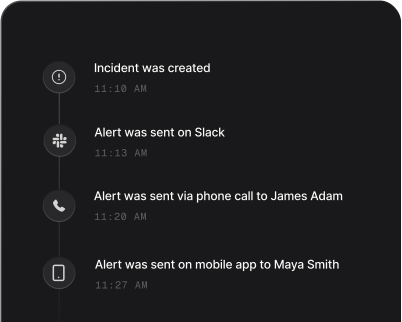
An Issue on its own waits in the Wiz queue for whoever next opens the console, which is fine for a weekly review and far too slow for a critical finding on an internet-facing workload. Connected to Spike, each Issue Wiz sends becomes an incident named after the control that fired and the resource it fired on — with the cloud platform, account, region, and Wiz project carried straight through from Wiz’s payload — and it pages the on-call engineer by phone and SMS within seconds, escalating to the next responder if it goes unacknowledged. Spike tracks the incident by the Wiz Issue ID, so later updates to the same Issue land on the existing incident rather than opening a second one, and the incident resolves itself the moment Wiz marks the Issue resolved or rejected.
Severity filtering stays on the Wiz side, in each rule’s condition, so a team that only wants to be woken for Critical findings can page on those while routing High and Medium Issues to a quieter rule — or to no rule at all.
How to set up Wiz alerts
Every Spike integration is a unique webhook URL. Paste it into Wiz and alerts start flowing — no agents, no code.
Step 1: Create a Wiz integration in Spike
In your Spike dashboard, open Integrations and choose Wiz. Spike generates a unique webhook URL for this integration — copy it.
Step 2: Add the webhook in Wiz
In Wiz, go to Settings, then Integrations, and add a Webhook integration. Paste the Spike URL as the endpoint. Wiz doesn't sign its webhooks, so pick Bearer authentication and set a token if you want the endpoint authenticated as well as unguessable.
Step 3: Add three automation rules that call the webhook
Under Automation Rules, add a rule for each of the Issue triggers — created, updated, and resolved — with the action pointed at your Spike webhook integration. Leave the request body as Wiz generates it: Spike reads Wiz's own Issue payload, so there's nothing to paste or map. Filter on severity in each rule's If condition, and Wiz sends only what you want paged.
Step 4: Keep the Issue-resolved rule and test
The Issue-resolved rule is what makes auto-resolve work: when Wiz resolves or rejects the Issue, the matching Spike incident closes itself. Trigger a test from a rule to confirm the incident opens, updates, and then resolves on its own.
That's it — Wiz alerts now page whoever is on call.