Get phone and SMS alerts fromMonte Carlo
Monte Carlo watches your warehouses, lakes, and pipelines for freshness, volume, schema, and custom rule breaks, and opens a data incident when something drifts. Spike pages a human for it — phone call, SMS, Slack, or email to the data engineer on rotation, escalating until someone picks it up.
Set up with AI
I use Monte Carlo for monitoring and Spike for on-call and incident management. Walk me through connecting them: create a Monte Carlo integration in Spike, copy its webhook URL, and add that webhook to Monte Carlo alert settings. Then help me send a test alert to confirm incidents show up in Spike.
What is Monte Carlo?
Monte Carlo is a data observability platform: it profiles the tables in your warehouse or lake and raises an incident when the data itself goes wrong — a table that stopped refreshing, a row count that collapsed, a schema that changed underneath a downstream model, or a custom rule that no longer holds. For a data team, those breaks matter the way a failing service does, because the dashboards, models, and customer-facing features built on that table are already serving something wrong.
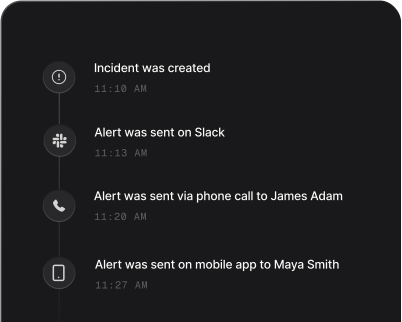
A Monte Carlo incident on its own lands in the app, an email, or a Slack channel that nobody reads at 3am. Routed to Spike, it becomes an incident with an owner: the on-call data engineer gets a phone call and an SMS within seconds, the alert escalates to the next person on the rotation if it goes unacknowledged, and every update Monte Carlo sends — acknowledged, status changed, owner reassigned — is appended to the same incident instead of arriving as another page.
Who gets paged, at what severity, and how fast it climbs is decided in Spike: alert rules read the table, monitor, and payload each Monte Carlo incident arrives with, so a stale marketing table doesn’t wake up the same people a broken revenue pipeline does. And because Spike reads Monte Carlo’s own lifecycle updates, an incident closes itself the moment the data issue is marked fixed, expected, no action needed, or a false positive — no leftover pages to sweep up by hand.
How to set up Monte Carlo alerts
Every Spike integration is a unique webhook URL. Paste it into Monte Carlo and alerts start flowing — no agents, no code.
Step 1: Create a Monte Carlo integration in Spike
In your Spike dashboard, open Integrations and choose Monte Carlo. Spike generates a unique webhook URL for this integration — copy it.
Step 2: Create a Webhook audience in Monte Carlo
In Monte Carlo, go to Settings → Notifications and create an audience. Choose Webhook as the channel and paste the Spike webhook URL; the signing secret is optional. Scope the audience to the domains, tables, or monitors whose incidents should page someone.
Step 3: Send incident updates and test
Include the incident lifecycle events — acknowledged, status updated, owner changed, marked as incident, and resolved — so Spike tracks the whole story. A new anomaly or custom rule incident opens an incident in Spike within seconds, and marking it fixed, expected, no action needed, or a false positive in Monte Carlo resolves it.
That's it — Monte Carlo alerts now page whoever is on call.