Get phone and SMS alerts fromSentry
Sentry captures errors, exceptions, and performance issues in your applications with full stack traces and context. Spike.sh turns every Sentry alert into an incident and puts it in front of the on-call engineer — a phone call, an SMS, a Slack message, or an email — escalating until it is acknowledged.
Set up with AI
I use Sentry for monitoring and Spike.sh for on-call and incident management. Walk me through connecting them: create a Sentry integration in Spike.sh, copy its webhook URL, and add that webhook to Sentry alert settings. Then help me send a test alert to confirm incidents show up in Spike.sh.
What is Sentry?
Sentry is a widely used error monitoring and performance platform that captures exceptions, crashes, and slow transactions the moment they happen — surfacing detailed stack traces, release context, and the affected users so engineers can reproduce and fix issues fast. Its alert rules fire when a new issue appears, an error rate spikes, or a performance threshold is crossed.
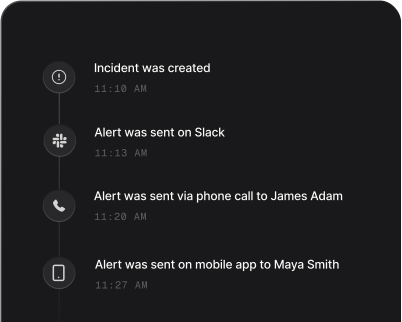
A Sentry alert on its own is an email or an in-app notification that is easy to miss when an application is failing for real users after hours. Connected to Spike.sh, the same alert becomes an incident: it calls and texts whoever is carrying the pager, promotes the issue to the next responder when the acknowledgement doesn’t land, and rolls repeat events from the same issue into a single incident rather than a fresh page for every occurrence. Note that resolving an incident in Spike.sh does not resolve the error in Sentry — the integration delivers alerts one way, so your Sentry issue list stays under your control.
How to set up Sentry alerts
Every Spike.sh integration is a unique webhook URL. Paste it into Sentry and alerts start flowing — no agents, no code.
Step 1: Create a Sentry integration in Spike.sh
In your Spike.sh dashboard, open Integrations and choose Sentry. Spike.sh generates a unique webhook URL for this integration — copy it. (You can add as many webhook integrations as you need.)
Step 2: Add the webhook in Sentry
In Sentry, go to Settings → Integrations, select Webhook, paste the Spike.sh webhook URL, and enable the plugin so Sentry can send events to Spike.sh.
Step 3: Create an alert rule and test
In Sentry's Alerts section, create an alert rule and, under Actions, select the webhook integration you just enabled. Trigger a new error in your app — it appears in Spike.sh as an incident within seconds.
That's it — Sentry alerts now page whoever is on call.