TL;DR: On-Call Management in a Nutshell
It’s 2 AM Monday. Your phone buzzes—the authentication system crashed. You wake up, fix it, and go back to sleep.
Tuesday, 3 AM. Another alert. The payment gateway failed. You drag yourself out of bed, fix it, and collapse back into bed.
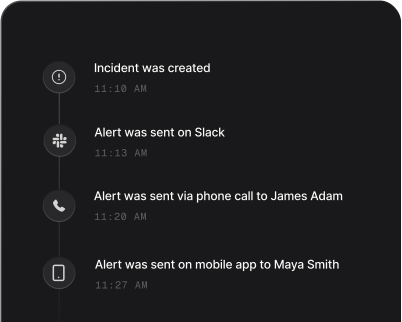
Wednesday, 4 AM. Your phone buzzes. The payment gateway broke… again. This time, you’re too tired to wake up. After 5 minutes, the system pings the backup responder, who handles the issue.
Though the issue was resolved, your sleep was interrupted—not one night but three consecutive nights. Do this week after week, and you’ll eventually burn out!
This is where on-call rotations come in. They rotate the first responders, sharing the on-call responsibility among team members.
For example, you might be on-call this week, and Michael handles the next. This spreads the load so nobody burns out.
But what about weekends when neither you nor Michael can be available? You can create another on-call schedule, where James covers weekends.
Now, on-call rotations and schedules are in place. But what if you have a dentist appointment during your shift? On-call overrides let you hand over your duties to Michael or James without leaving systems unprotected.
Not a dentist appointment, but what if you need a short 15-minute break after a tough incident? Well-being features like cooldown mode gives you a breathing room without dropping coverage.
That’s On-Call Management at its core—making sure someone’s always ready to respond while keeping your team healthy and alert.
Transform your on-call experience today!
Join hundreds of teams using Spike to create balanced rotations, manage schedules, and protect your team’s well-being—all in one place.
Start your 14-day free trial now →
What is On-Call Management?
On-call management is a system where team members take turns being first responders to incidents. It makes sure someone is always ready to jump in when an incident strikes, even at 3 AM on a Sunday.
The goal is straightforward: maintain service continuity by having the right people available at the right time. This means minimizing downtime, addressing issues quickly, and keeping your systems running smoothly around the clock.
However, on-call management isn’t about making team members miserable with midnight alerts. It’s about creating fair rotations, clear responsibilities, and sustainable practices that protect both your services and team’s well-being.
Why is On-Call Management Important?
On-Call Management keeps your business running, even when problems hit after work hours. Without it, issues can go unnoticed for hours, leading to lost revenue and unhappy customers.
Let’s take an example to understand it better.
Example: Imagine you run a video streaming service. At 11 PM Saturday, your content delivery network (CDN) goes down. Users can’t watch their favourite shows and start complaining on social media.
Without on-call management, there would be no designated on-call engineer to cover weekends. And your team might not notice the issue until Monday morning. By then, you’d have thousands of angry customers and lost revenue.
However, with on-call management in place, the on-call engineer who is responsible for the weekend is alerted immediately.
They acknowledge the incident, start troubleshooting within minutes, and fix the CDN issue. By midnight, service is restored.
What could have been 36+ hours of downtime and a PR nightmare becomes a brief one-hour interruption that most users barely notice.
Such effective responses during downtime also show customers they can trust you, which protects your brand’s reputation.
Don’t let weekend incidents become Monday disasters!
Spike helps you create reliable on-call rotations, manage schedules, and keep your services running smoothly—even at 11 PM on weekends.
Get started with Spike today →
Key Components of On-Call Management
| Component | Purpose |
|---|---|
| On-Call Schedules | Define who responds to incidents and when |
| On-Call Rotations | Share the burden of being available across the team |
| Handoffs | Transfer responsibility smoothly between on-call engineers |
| On-Call Overrides | Reassign on-call duty when the scheduled person becomes unavailable |
| On-Call Well-Being Features | Protect the team from burnout and support work-life balance |
Effective On-Call Management involves several building blocks. Let’s explore each with our CDN-failure example and understand how they function in real-world situations.
1. On-Call Schedules
On-call schedules define who responds to incidents and when. They remove confusion and create clarity on who receives alerts when problems arise.
For our streaming service, we have two schedules:
- A weekly schedule covering Monday to Friday
- A weekend schedule covering Saturday and Sunday
Effective schedules cover all hours without gaps. They map out who’s responsible during nights, weekends, and holidays so there’s always someone ready to jump in.
2. On-Call Rotations
On-call rotations share the burden of being available across your team. This prevents any one person from getting stuck with all the late-night calls.
Our streaming team uses weekly rotations:
- Week 1: Sheldon (primary) and Amy (backup) handle weekdays
- Week 2: Leonard (primary) and Penny (backup) take over weekdays
- Week 1: Howard (primary) and Bernadette (backup) cover weekends
- Week 2: Raj (primary) and Emily (backup) handle weekends
When the CDN fails at 11 PM Saturday, Howard (as the primary weekend responder) gets the alert. If he doesn’t respond within 5 minutes, Bernadette would be alerted as the backup responder.
Check out Spike’s easy-to-use on-call rotation templates →
3. Handoffs
Handoffs transfer responsibility smoothly from one on-call engineer to the next. They provide critical context about ongoing issues or potential problems.
When Friday ends and Howard takes over for the weekend, Sheldon might share notes about potential CDN issues he noticed during the week. This context helps Howard respond more effectively when the CDN actually fails on Saturday night.
Effective handoffs typically include a brief meeting or written summary of current system status, recent incidents, and any other concerns. This context helps the incoming engineer respond more effectively to new alerts.
4. On-Call Overrides
On-call overrides let you reassign responsibility when life gets in the way. They add flexibility when unexpected things happen.
If Howard has a family emergency during his Saturday shift, he can quickly transfer his on-call duties to Raj. The system then routes all new alerts to Raj instead.
Overrides keep your services covered while respecting that on-call engineers have lives outside work.
5. On-Call Well-Being Features
On-call well-being features protect your team from burnout. They create sustainable on-call practices that respect work-life balance.
For our streaming team, these might include:
- Quiet hours where only critical alerts come through
- Time off after handling major incidents
These features acknowledge that humans need rest. After Howard handles the CDN failure at 11 PM, he might need a 30-minute break to recover.
Spike offers different availability modes to help manage on-call stress:
Cooldown Mode: Lets you temporarily pass duties to others so you can catch a breather after an incident.
Out of Office Mode: Helps you fully disconnect from alerts when you’re on leave, allowing for proper rest.
Deep Work Mode: Silences non-critical alerts, letting you focus without missing high-priority issues.
Different Types of On-Call Models
| On-call model | How it works | Best suited for |
|---|---|---|
| Follow the Sun Model | Teams in different time zones handle incidents during their daytime hours and pass responsibility as their workday ends | Global or remote teams needing 24/7 coverage without night shifts |
| Primary/Secondary Model | Incidents go to primary responders first. Complex issues are escalated to secondary experts if needed | Teams with varying experience levels and complex systems where specialized knowledge is needed |
| Rotation Model | Team members take turns being on-call for fixed periods, then pass responsibility to the next person | Teams with similar skill sets who can handle most incident types |
| Fixed Schedule Model | Team members are assigned specific, consistent days or times for on-call duties | Teams with varying availability, personal constraints, or organizations with part-time staff |
| Skills-Based Routing | Alerts route directly to people with matching expertise | Complex environments with specialized systems requiring specific knowledge |
How you structure your on-call system can make the difference between a sustainable approach and one that burns out your team. Let’s explore five common on-call models for effective rotation.
1. Follow the Sun Model
The Follow the Sun model spreads on-call duties across teams in different time zones. Each team handles incidents during their daytime hours, then passes responsibility to the next team as their workday ends. This creates 24/7 coverage without anyone working nights.
Teams literally “follow the sun” around the globe, with work handed off from one location to the next several time zones west.
Advantages:
- No one works outside their normal daytime hours
- Teams stay fresh and alert when handling incidents
- Problems get solved faster with continuous work
Drawbacks:
- Handoffs can be complex and risk dropping context
- Communication challenges across different locations
Best suited for: Global companies with established teams across multiple time zones who need 24/7 coverage without night shifts.
2. Primary/Secondary Model
The Primary/Secondary model creates a response hierarchy. Primary responders handle initial triage and fix simple issues. For complex problems, they call in secondary responders with deeper expertise.
Advantages:
- Less-experienced team members can safely handle the front-line response
- Experts only get involved when truly needed
- Creates natural mentoring opportunities
Drawbacks:
- May cause delays during escalation
- More workload may fall on secondary responders
Best suited for: Teams with varying experience levels and complex systems where specialized knowledge is often needed.
3. Rotation Model
The Rotation model cycles on-call responsibility through team members for fixed periods. Each person takes a turn being on-call for a set duration (usually a day, week, or two weeks) before passing the baton to the next person.
Advantages:
- Fair distribution of on-call burden
- Predictable schedule allows personal planning
- Simple to set up and follow
Drawbacks:
- Everyone needs broad knowledge to handle various incidents
- Doesn’t account for different expertise areas
Best suited for: Teams where members have similar skill sets and can handle most types of incidents.
4. Fixed Schedule Model
The Fixed Schedule model assigns specific time slots to team members based on their preferences and availability. Unlike rotations, these schedules stay consistent week to week.
Advantages:
- Accommodates personal preferences and constraints
- Creates predictable, consistent schedules
- Works well for teams with part-time members
Drawbacks:
- Less flexible for handling vacations or sick days
- May create knowledge silos
Best suited for: Teams with varying availability or personal constraints, or organizations with part-time staff.
5. Skills-Based Routing Model
The Skills-Based model routes alerts to people based on their expertise. Instead of one person handling everything during their shift, alerts go to whoever knows that system best.
Advantages:
- Problems reach the most qualified person right away
- Complex issues get fixed faster
- Reduces unnecessary escalations
Drawbacks:
- Harder to maintain fair workload distribution
- Requires sophisticated alert routing capabilities
Best suited for: Complex environments with specialized systems requiring specific knowledge.
The right on-call model depends on your team size, geographic distribution, expertise levels, and the nature of your systems.
Many organizations use hybrid approaches, combining elements from different models to create a system that works for their specific needs.
Getting Started: Setting Up Your On-Call System
Creating your on-call system doesn’t need to be complicated. Follow this simple 4-step process to build a foundation that works for your team without burning them out.
Step 1: Identify Services That Need Coverage
Ask yourself: “What’s one alert I’d wake up even at 3 AM?” This question helps you identify critical services that need 24/7 coverage.
For an e-commerce site, this might be payment processing or the checkout flow. For a SaaS platform, it could be the login system or core API services.
Not everything deserves a middle-of-the-night phone call. Focus on services where downtime directly affects users or business operations.
Step 2: Choose Your Team Members
Pick people who understand your systems well. They should know when to fix things themselves and when to call for help.
Be realistic about your team size. The number of people you have will shape your rotation and affect the team’s work-life balance.
Step 3: Determine Your Rotation Pattern
Choose a rotation model that fits your team’s size and needs. Weekly rotations work well for many teams, but daily or custom patterns may suit you better.
Add a secondary on-call person as backup. If the primary doesn’t respond within 5 minutes, the secondary gets alerted.
Step 4: Set Clear Expectations
Document what on-call engineers should do when alerts fire. This includes:
- How quickly they should respond to different alert types
- Basic troubleshooting steps for common problems
- When and how to escalate issues
- What tools they need available during their shift
Share this information with everyone on the team. Clear expectations help avoid confusion and make on-call shifts smoother for all.
Once you’ve set up your on-call system, run practice drills. They help identify gaps before a real incident strikes. After your first few actual incidents, gather feedback from the team and adjust your approach as needed.
Ready to build your on-call system?
Spike makes setting up your on-call system simple with customizable schedules, balanced rotations, and built-in well-being features that protect your team from burnout.
Get started with Spike today →
Best Practices in On-Call Management
- Document everything: Keep clear, accessible guides for procedures, common issues, and fixes. Good documentation helps resolve incidents faster.
- Provide required access and tools: Make sure your on-call team has all necessary permissions, logins, and tools before they start their shift.
- Shadow on-call for training: Let new team members observe experienced engineers before joining the rotation. This builds skill and confidence without risk.
- Create sustainable rotations: Design schedules that allow enough rest between shifts. Avoid back-to-back on-call periods to prevent burnout.
- Prioritize on-call well-being: Use features like quiet hours and filter non-urgent alerts overnight. Only wake up engineers for true emergencies.
- Automate routine responses: Identify alerts with standard fixes and automate them. This keeps engineers focused on real problems and reduces alert fatigue.
- Provide fair compensation: Sometimes, on-call work may extend. Offer extra pay, time off, or other benefits so team members feel valued.
- Involve multiple teams: Include product, support, or other departments in the rotation when appropriate. This spreads knowledge and responsibility.
- Review schedules regularly: Check for uneven alert loads or signs of burnout. Adjust rotations and alerting rules as needed.
- Measure and improve: Track metrics like response time and alert volume. Use this data to refine your on-call management process.
- Recognize on-call contributions: Thank team members for their extra effort. Recognition keeps morale high and shows that on-call work matters.
Common Challenges of On-Call Management and How to Overcome Them
1. Burnout
Constant alerts, especially at night or on weekends, can quickly drain team members. This leads to fatigue, decreased performance, and eventually people leaving the team.
Create sustainable rotations with adequate rest periods between on-call shifts. Plus, implement “cooldown” periods after high-intensity incidents so engineers can recover.
Spike offers Cooldown and Out-of-office modes to avoid burnout →
2. Alert Fatigue
Too many alerts, especially false alarms, make engineers start ignoring alerts altogether. When every alert seems urgent, none of them feel important.
Filter out non-critical alerts and implement tiered alerting systems where only truly critical issues trigger phone calls. Use tools like Spike that automatically suppress repeat incidents and route alerts based on severity. Regularly review and refine alert thresholds to reduce noise.
3. Handoff Issues
Poor handoffs between shifts leave the incoming on-call engineer without crucial context. This leads to slower response times and repeated work.
Create structured handoff processes with documentation of ongoing issues. Schedule brief overlap periods between shifts for live knowledge transfer. Maintain centralized documentation that all team members can access.
4. Uneven Skill Distribution
When only a few team members understand critical systems, they bear a disproportionate on-call burden. This creates single points of failure and unfair workloads.
Implement shadow on-call rotations where less experienced engineers observe and assist more senior ones. Plus, cross-train team members regularly on different critical systems.
5. Peak Load Management
During high-traffic periods or major releases, incident volume can spike dramatically. This overwhelms the standard on-call rotation.
Analyze historical data to anticipate peak times and adjust schedules accordingly. Consider implementing “all hands” protocols for major events where additional support is available. Create specific playbooks for handling increased load during predictable busy periods.
Conclusion: Building a Sustainable On-Call System
On-call management doesn’t have to be a nightmare of 3 AM alerts and burned-out team members. The key is balance—between system reliability and team wellbeing.
Start small with just your most critical services. Not everything needs immediate attention at midnight. Focus first on what truly impacts your users or revenue.
Create rotations that respect human limits. A sustainable on-call system needs enough people to share the load. With fewer team members, consider limiting on-call hours or coverage scope until your team grows.
Listen to your on-call engineers. The people handling alerts know best what’s working and what isn’t. Regular check-ins to gather feedback help you continuously improve your process.
Make on-call a learning opportunity. Each incident teaches something valuable about your systems. Document these lessons and share them across the team to build collective knowledge.
Recognize and reward on-call work. Whether through compensation, time off, or public recognition, show your team that their work matters.
Remember that on-call management is a journey, not a destination. Your approach should evolve as your team grows and systems change.
Take that first step today. Set up a basic rotation for your most critical service. Your team will thank you when that weekend incident becomes a minor interruption rather than a major crisis.
Ready to build a sustainable on-call system?
Spike helps you create balanced rotations, reduce alert noise, and protect your team from burnout—all with an intuitive platform designed for modern teams.
FAQs
Should we include non-technical team members in on-call rotations?
Yes, consider including product or support teams for certain types of incidents. Technical issues need engineers, but customer communications might work better with support teams handling them. This spreads the workload and builds shared ownership.
How do we handle knowledge transfer between on-call shifts?
Create simple handoff notes about ongoing issues and potential trouble spots. Schedule a brief overlap between shifts for live updates. Keep all documentation in one place that everyone can access easily.
How do we handle on-call during holidays?
Distribute holiday duties fairly across the team. Share the schedule well ahead of time so people can plan their celebrations. Consider shorter shifts during holidays and extra compensation for those working during special occasions.
Is on-call management the same as incident management?
They’re related but different. On-call management decides who responds to alerts. Incident management is the overall process of handling issues from detection to resolution.