

Atlassian is shutting down OpsGenie. New sales stopped on June 4, 2025, and the platform will be completely offline by April 5, 2027.
As an OpsGenie user, you now face a critical decision: Migrate to Jira Service Management (JSM), Atlassian’s recommended path, or choose a different solution.
In the previous post, I reviewed JSM’s alerting capabilities and discussed how it gets the core alerting features right. JSM offers dual control over alerts, solid Slack integration, and mirrors OpsGenie’s familiar workflow.
But you’re here because something about JSM isn’t working for you. Maybe you need team-level control over how alerts are delivered. Perhaps the inability to reply to email alerts is a problem. Or it could be the nested interface that makes setup harder than it should be.
This blog post presents 5 better JSM alternatives for alerting. I have also included a detailed checklist to help you look at the finer details.
This isn’t just another listicle. I signed up for and tested every alternative mentioned here. I created an email integration, designed escalation policies, and triggered test alerts to assess each tool’s alerting capabilities.
My goal is to help you find the right JSM alternative for your team.
Let’s get started.
Table of Contents
5 Better Jira Service Management (JSM) Alternatives for Alerting
| Tool | Best for | Starting Price |
|---|---|---|
| Spike | Teams wanting affordable, user-friendly alerting with team and individual control | $7/user/month |
| PagerDuty | Teams needing ML-based noise reduction and service-specific on-call handoff alerts | $25/user/month |
| Incident.io | Teams operating primarily in Slack or Teams who want deep customization | $19 base + $12/on-call user/month |
| Squadcast | Engineering teams needing ML-based routing and service-specific working hours | $12/user/month |
| Zenduty | Teams wanting structured workflows with task templates and SLA tracking | $6/user/month |
1. Spike
Spike is a modern incident management platform built to be a simpler, more affordable alternative to JSM. It has powerful alerting capabilities without the complex workflows and high costs.
Why Choose Spike Over JSM
- Unlike JSM, Spike lets you specify exactly how someone gets alerted. You can tell Spike to call a team member first, then send an SMS if they don’t respond. JSM forces you to rely on each user’s personal preferences.
- You can reply to alert emails with
#ackor#resto take action. JSM email alerts only show a button to view the alert. You have to click through and leave your inbox. - Spike not only alerts when on-call shifts change, but also triggers webhooks to automate tasks like granting database access, running health checks, etc, when rotations update.
- Spike uses relative timing in escalation policies. You just set “escalate after X minutes” for each step. JSM makes you calculate the delay time from the top of your policy.
Limitations
Spike doesn’t offer separate phone numbers for calls and SMS. On JSM, you can use different numbers for each channel.
Also, with JSM, you can set alert processing rules (when to ignore, acknowledge, resolve, or add notes to alerts) for each integration, which is not possible on Spike.
Starting Price: $7/user/month
Best for
Teams of any size looking for a fast, user-friendly, and affordable JSM alternative for alerting. Perfect for those who want both individual and team-level control over alert delivery methods.
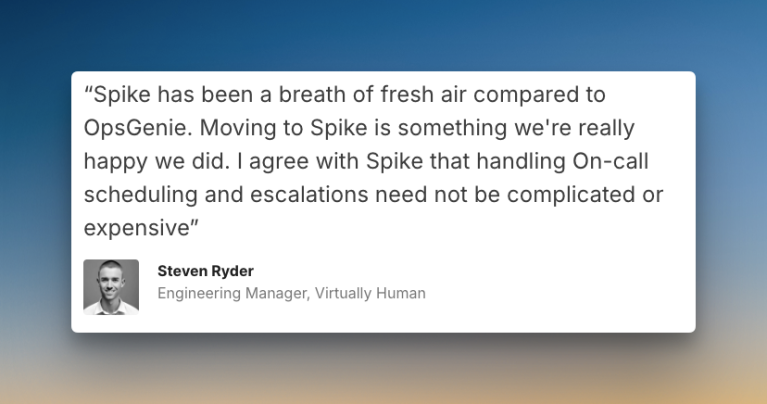
Hear what Steven Ryder, former Engineering Manager at Virtually Human, said about Spike
With OpsGenie shutting down, businesses are switching to Spike with 50% off. Learn more →
2. PagerDuty
PagerDuty is a mature incident management platform with advanced alerting features. It’s built for teams that need enterprise-grade capabilities and machine learning-powered noise reduction.
Why Choose PagerDuty Over JSM
- PagerDuty uses AIOps with machine learning to find patterns and group related incidents. JSM, on the other hand, relies on manually setting up Notification Policies and Alert Policies.
- You get service-based on-call handoff notifications. You can control which services trigger shift alerts and keep non-critical ones quiet.
- PagerDuty lets you instantly trigger test alerts. This helps you check if your notification channels work correctly. JSM does not offer a way to send test alerts, so you have to wait for a real incident to verify your setup.
- PagerDuty’s Slack alerts offer more options than JSM. You can create incident channels, assign roles, add tasks, and more.
Limitations
PagerDuty gives control over alerts entirely to individuals. Team leads can’t customize how their members get alerted for different situations. JSM offers dual control at the team and individual levels.
PagerDuty’s ML-based noise reduction costs extra at $799 per month. JSM includes Notification Policies and Alert Policies in the base price.
Starting Price: $25/user/month
Best for
Enterprise teams that need ML-based alert grouping and can afford the higher price. Good fit for organizations that want service-specific on-call handoff notifications.
3. Incident.io
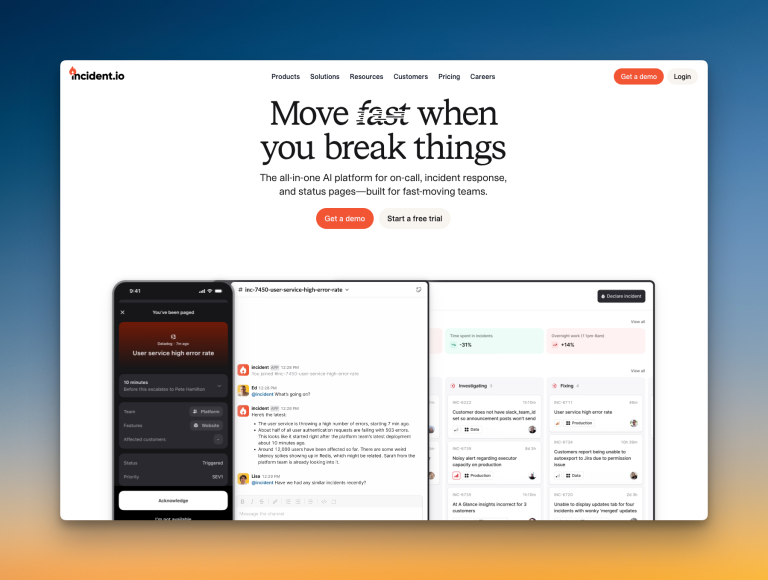
Incident.io is a chat-native incident management platform. It is built to handle alerts and coordinate responses mainly within Slack and Teams.
Why Choose Incident.io Over JSM
- You can auto-subscribe to incidents based on conditions like impact or severity. JSM doesn’t offer automatic subscription rules. Incident.io makes sure you get notified about relevant incidents automatically.
- Escalation policies use an intuitive flowchart style with if-else conditions. JSM uses a list-based approach.
- You can add filters to allow only certain alerts to reach responders. JSM requires more manual configuration. Incident.io’s filtering feels easier.
- Alerts can be held in triage state. An escalation policy only runs after a responder declares it an incident. JSM doesn’t offer this triage feature to reduce noise.
Limitations
The initial setup feels more complex than JSM. You can’t acknowledge or resolve alerts from the email itself in either tool.
JSM has a more straightforward service and escalation setup. Incident.io’s diverse customization options mean more cognitive load during configuration.
Starting Price: $19 (base fee) + $12 (on-call) per user per month
Best for
Teams that want deep customization for alerting workflows and don’t mind the setup complexity. It is a good fit for organizations that operate primarily out of Slack or Microsoft Teams.
4. Squadcast
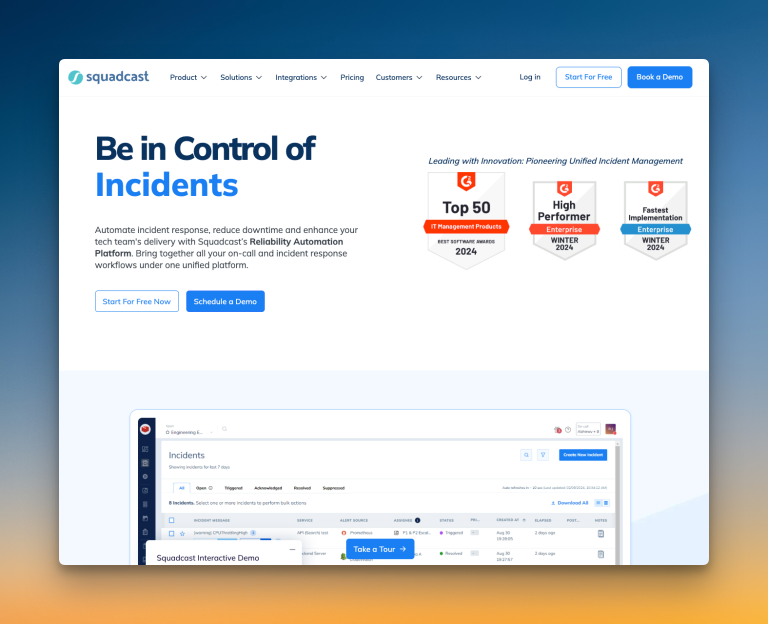
Squadcast is an incident management platform designed for reliability engineering teams. It offers advanced alert routing and intelligent noise reduction.
Why Choose Squadcast Over JSM
- Unlike JSM, Squadcast lets you choose personal or custom routing in escalation policies. You can route alerts according to users’ personal preferences or specify a custom method.
- You can choose round-robin routing for each escalation step. JSM offers notify next, previous, or random member options, but not round-robin routing.
- Squadcast lets you set working hours for each service, which gives you more granular control. On the other hand, JSM handles time-based routing through general rules.
- It uses real-time machine learning to group related alerts intelligently. JSM requires manual setup through Notification Policies.
Limitations Compared to JSM
You cannot trigger test alerts to check if your notification channels work correctly. JSM doesn’t offer test alerts either. Both platforms make you wait for real alerts to verify setup.
Squadcast offers many configuration options at each step. JSM feels a bit more streamlined. However, both platforms require you to make many decisions during setup.
Starting Price: $12/user/month
Best for
Engineering teams that want advanced alert routing with machine learning capabilities. Good fit for organizations that need service-specific working hours.
5. Zenduty
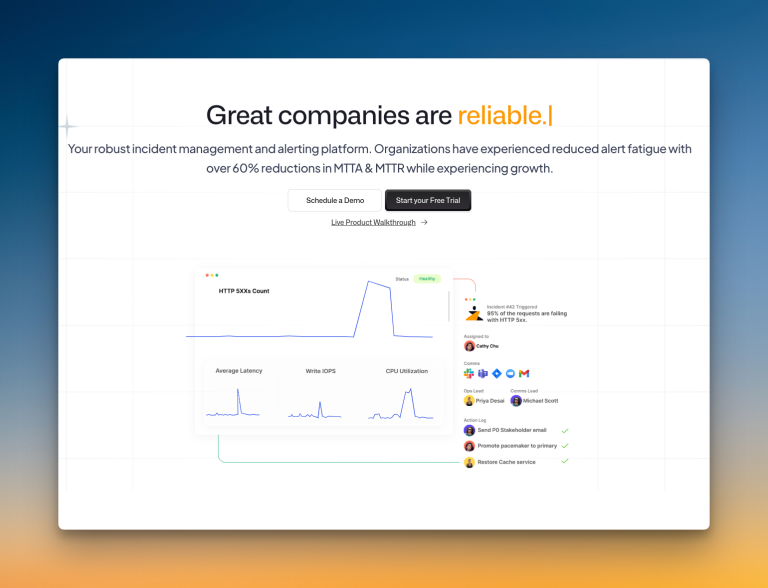
Zenduty is an incident management platform focused on reliability and response automation. It combines alerting with workflow management to help teams respond to incidents efficiently.
Why Choose Zenduty Over JSM
- Escalation policies have a “Move to next rule if no user is found” option. This prevents policies from getting stuck if you forget to add someone. JSM doesn’t offer this safety feature.
- You can add task templates and SLA policies to each service. Task templates work like checklists for new team members. JSM doesn’t offer service-specific task templates.
- You can acknowledge or resolve incidents directly from email alerts. JSM email alerts only show a button to view the alert. Zenduty saves you time by letting you reply directly.
- With Zenduty, you can silence alerts with one click to stop noise during an incident. In JSM, you must edit an alert policy, which is a slower process that can break your focus.
Limitations Compared to JSM
The repeat escalation feature only allows fixed 1-minute delays between repetitions. JSM lets you customize the delay time. One minute feels too short for most teams.
There’s no wait time at the start of escalation policies for auto-resolved incidents. JSM handles this better with more flexible timing options. Getting alerts on specific Slack channels requires creating outgoing integrations in Zenduty. JSM’s Slack setup is relatively more direct.
Starting Price: $6/user/month
Best for
Teams that need structured incident response with task templates and SLA tracking. Good fit for organizations that want detailed workflow management alongside their alerting.
Alerting Checklist: How Each Tool Stacks Up
Though we’ve covered the alerting capabilities of each tool in depth, some finer details can make a real difference in your daily operations. This checklist breaks down those specifics for you.
| Criteria | JSM | Spike | PagerDuty | Incident.io | Squadcast | Zenduty |
|---|---|---|---|---|---|---|
| Ready-to-use escalation and alert rule templates | ❌ | ✅ | ❌ | ❌ | ❌ | ❌ |
| Alert title or payload rewriting/remapping | ✅ | ✅ | ✅ | ✅ | ✅ | ✅ |
| Native alert deduplication, grouping, and suppression | ✅ | ✅ | ✅ | ✅ | ✅ | ✅ |
| Time-based escalations (business hours, off-hours) | ✅ | ✅ | ✅ | ✅ | ✅ | ✅ |
| Channel-specific escalation rules (e.g. phone for primary, push for secondary) | ❌ | ✅ | ❌ | ❌ | ✅ | ❌ |
| ML-based noise reduction | ❌ | ❌ | ✅ | ❌ | ✅ | ❌ |
| Acknowledgment timeouts with automatic re-alerting | ✅ | ✅ | ✅ | ❌ | ✅ | ✅ |
| DND/silence bypass for only critical alerts | ✅ | ✅ | ✅ | ✅ | ❌ | ✅ |
| Native WhatsApp/Telegram alerting with two-way acknowledgment | ❌ | ✅ | ❌ | ❌ | ❌ | ❌ |
| Customizable voice call settings (gender, speed) | ❌ | ✅ | ❌ | ❌ | ❌ | ❌ |
| AI-driven root cause suggestions | ❌ | ❌ | ✅ | ✅ | ❌ | ✅ |
| Acknowledge/resolve/comment from chat apps (Slack, Teams) | ✅ | ✅ | ✅ | ✅ | ✅ | ✅ |
Clearly, Spike tops the checklist with the broadest set of alerting features that matter in your daily operations.
Final Thoughts
The OpsGenie shutdown forces you to make a choice. Sticking with Atlassian’s path by moving to JSM is one option. It feels familiar, but it also means inheriting its limitations.
You might need more control over how your team gets alerted. Or maybe you want to take action directly from an email. These are some features where JSM falls short. And there are many such drawbacks.
This blog showed you five alternatives that fill JSM’s gaps. Each alternative was tested to see how it performs in the real world. The final choice depends on what your team truly needs.
If you are looking for a tool that keeps the best parts of OpsGenie while fixing its frustrations, Spike is worth a look. It is simple, powerful, and built for teams that just want their alerting to work.