Get phone and SMS alerts fromBugsnag
Bugsnag captures the errors and crashes your users actually hit — across web, mobile, and platforms like tvOS — with the stack traces and context to debug them. Spike.sh turns Bugsnag alerts into incidents, routed to the on-call engineer by phone, SMS, Slack, and email, with escalations if nobody responds.
Set up with AI
I use Bugsnag for monitoring and Spike.sh for on-call and incident management. Walk me through connecting them: create a Bugsnag integration in Spike.sh, copy its webhook URL, and add that webhook to Bugsnag alert settings. Then help me send a test alert to confirm incidents show up in Spike.sh.
What is Bugsnag?
Bugsnag is an application error and crash monitoring tool. Its SDKs sit inside your web, backend, and mobile apps — including platforms like tvOS — and report unhandled exceptions and crashes as they happen, grouped by error with the stack trace, breadcrumbs, and device context an engineer needs to reproduce them. It tells you not just that something broke, but which release and which users it hit.
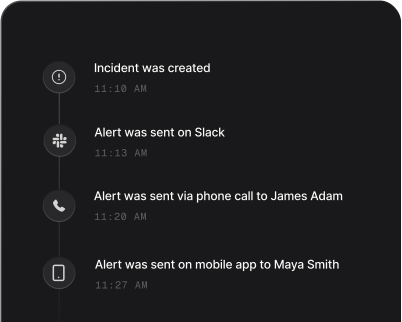
A Bugsnag alert on its own arrives as an email or a Slack message that is easy to overlook when a new crash spikes overnight. Connected to Spike.sh, a Bugsnag error becomes an incident: the on-call engineer gets a phone call and SMS within seconds, the alert escalates to the next responder if it goes unacknowledged, and repeated reports of the same error are grouped so a single regression doesn’t flood the rotation. Because Spike.sh reads Bugsnag’s resolve events, the incident closes itself the moment the error is marked fixed, keeping your timeline honest.
How to set up Bugsnag alerts
Every Spike.sh integration is a unique webhook URL. Paste it into Bugsnag and alerts start flowing — no agents, no code.
Step 1: Create a Bugsnag integration in Spike.sh
In your Spike.sh dashboard, open Integrations and add Bugsnag. Spike.sh generates a unique webhook URL for this integration — copy it. You can create one integration per project to segment errors across services.
Step 2: Open Data Forwarding in Bugsnag
In Bugsnag, open the project you want to watch, go to Settings, and find the Data Forwarding section, which lists the available forwarding destinations.
Step 3: Add the webhook and test
Under Data Forwarding, choose Webhook and paste the Spike.sh webhook URL. Save it, then trigger a test error — it appears in Spike.sh as an incident within seconds and auto-resolves when the error is marked fixed.
That's it — Bugsnag alerts now page whoever is on call.